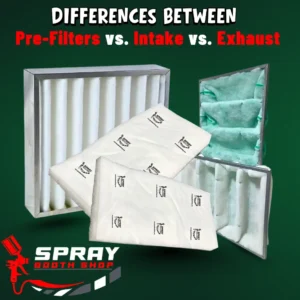
Pre-Filters vs. Intake Filters vs. Exhaust Filters: A Complete Guide to Their Key Differences
In our modern world, the air we breathe and the systems we rely on are constantly bombarded by invisible particles. From industrial processes to the simple act of heating a home, controlling air quality is not a luxury—it’s a necessity for health, safety, and operational excellence. This silent, crucial work is performed by an array of filters, the unsung heroes working within our machines and ventilation systems. Yet, not all filters are created equal. They are specialized tools, each designed with a distinct purpose, location, and capability. The global air filters market is a testament to their importance, estimated to reach USD 28.58 Billion by 2032, reflecting a growing global demand for cleaner, safer air.
Why Filters Differences Matters
The terms pre-filter, intake filter, and exhaust filter are often used, but the critical distinctions between them can be hazy. This lack of clarity can lead to inefficient systems, premature equipment failure, health hazards, and costly non-compliance. Choosing the wrong filter is like using a fishing net to catch sand; the tool is simply mismatched for the task. Understanding their unique roles is fundamental to creating an effective, multi-stage filtration strategy where each component supports the others, ensuring the entire system functions at its peak.
This guide will demystify the world of air filtration by providing a clear, thoughtful comparison of these three essential filter types. We will explore their core functions, strategic placement, the contaminants they target, and their impact on overall system performance. By the end, you will understand the synergistic relationship between these components and be better equipped to make informed decisions for your specific application, whether it’s a commercial spray booth, an industrial enclosure, or a residential HVAC system.
Understanding Filtration Fundamentals
Before dissecting the specific types, it’s essential to grasp the core principles that govern how all filters work. Filtration is a science of control—managing what enters, moves through, and exits a system.
What is a Filter and Why Do We Need Them?
At its most basic, a filter is a porous medium that removes unwanted particles from a fluid (like air) that passes through it. We need them for two primary reasons: protection and control. Filters protect sensitive downstream components—like engines, blowers, and high-efficiency secondary filters—from damaging debris. They also control the quality of the air, either to ensure a pristine process environment, safeguard human health, or prevent harmful pollutants from being released into the atmosphere. The staggering fact that 40% of Americans lived in places with unhealthy levels of particle pollution in 2021 underscores the critical role filtration plays in public health.
Particulate Capture, Airflow, and Differential Pressure
Three key principles dictate a filter’s performance. Particulate Capture refers to the filter’s ability to trap particles of specific sizes. Airflow is the volume of air that can pass through the filter over a given time; every filter creates some resistance to airflow. This resistance is measured as Differential Pressure (DP), the difference in air pressure between the dirty side and the clean side of the filter. As a filter captures more contaminants, its DP increases, restricting airflow and signaling that it’s time for a replacement.
Materials and Impact on Performance
The material a filter is made from—its media—is the heart of its functionality. Materials like fiberglass, pleated paper, synthetic polymers, foam, and even activated carbon are chosen based on the target particle size, required efficiency, airflow needs, and operating conditions. The structure, density, and composition of the media directly determine what it can capture and how much it will resist airflow, making material selection a critical aspect of filter design.
Deep Dive 1: Pre-Filters – The First Line of Defense
Pre-filters are the robust gatekeepers of any multi-stage filtration system. Their job is not one of finesse but of brute-force protection, forming the essential first barrier against the largest and most abundant contaminants.
Definition and Primary Purpose: Protecting Downstream Filters and Components
A pre-filter is a primary filtration stage designed to capture large airborne particles before they reach more delicate and expensive downstream filters. Its core purpose is sacrificial: it clogs so that finer, more critical filters don’t have to. By shouldering the bulk of the particulate load, a pre-filter dramatically extends the service life of subsequent filters, leading to significant cost savings and more consistent system performance.
Where You’ll Find Them: Typical Placement in Multi-Stage Systems
As their name implies, pre-filters are always placed “pre,” or upstream, of the main filtration stages. You will find them at the initial air intake point of an HVAC system, inside an industrial equipment enclosure before the main ventilation fan, or as the first layer in a complex air purifier or spray booth.
What They Catch: Common Contaminants
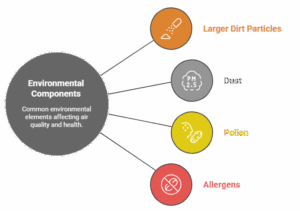
Pre-filters excel at capturing the “big stuff.” This includes visible dust, lint, hair, larger pollen grains, and other sizable airborne debris. They are not to stop microscopic particles, viruses, or chemical vapors. Their goal is to clear the air of the largest particles that would otherwise overwhelm more sensitive filters in a matter of hours or days.
Common Materials and Construction: Mesh filters, Foam, Pleated Fiberglass, Synthetics
Pre-filter media are chosen for durability and high dust-holding capacity. Common materials include washable foam, simple mesh screens made from materials like stainless steel, pleated fiberglass panels, and non-woven polyester pads. The construction often prioritizes maximizing surface area to hold a large volume of dirt without causing an immediate and drastic drop in airflow.
Performance Characteristics: Lower MERV Ratings, High Air Volume, Often Washable, Service Life Extension
Pre-filters typically have lower MERV (Minimum Efficiency Reporting Value) ratings, often in the 1-4 range. This low rating is by design; it indicates a focus on capturing larger particles (>10 microns) while allowing high volumes of air to pass through with minimal resistance. Many pre-filters, particularly foam or mesh types, are washable and reusable, adding to their cost-effectiveness. Their single most important performance characteristic is their ability to extend the life of the more expensive filters they protect.
Deep Dive 2: Intake Filters – Guarding the Gateway
While pre-filters offer protection, intake filters are about perfection. Positioned at a system’s primary entry point, they are responsible for conditioning the incoming air to meet the precise requirements of a process or piece of equipment.
Definition and Primary Purpose: Preventing Contaminants from Entering a System
An intake filter is designed to clean the air as it enters a system, preventing harmful particulates from damaging critical internal parts or compromising a controlled environment. Unlike a pre-filter that primarily protects other filters, an intake filter’s main job is to protect the machine, the process, or the people within the system. For example, in an engine, the intake filter prevents abrasive dust from scoring cylinders. The significant growth of the global automotive air filters market to an estimated USD 4.86 billion in 2024 highlights their critical role in vehicle performance and longevity.
Where You’ll Find Them: Positioned at the System’s Entry Point
Intake filters are located at the gateway of a system. This could be the air intake of an engine, the supply plenum of an Air Conditioner or furnace, or the ceiling of a paint spray booth where clean air is introduced. Their placement ensures that all air entering the operational heart of the system is purified.
Protecting Critical Parts from Harmful Particulates
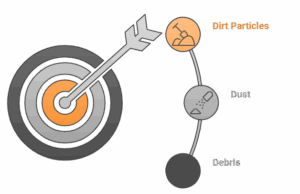
Intake filters are more efficient than pre-filters, designed to capture a wider range of finer particles. They trap the fine dust, pollen, and other debris that can bypass a pre-filter. In high-purity applications, this category includes HEPA filters, which can capture 99.97% of particles down to 0.3 microns. The global HEPA filter market is expected to reach an estimated $4.7 billion by 2028, reflecting their growing importance. For removing odors and volatile organic compounds (VOCs), Activated Carbon Filters are often used as an intake filter stage.
Common Materials and Construction: Pleated Paper, Synthetic Media, Fiberglass, Donaldson media
The construction of intake filters focuses on balancing efficiency with airflow. Pleated paper or synthetic media are common, as pleating dramatically increases the surface area for filtration without overly restricting air. In applications like a spray booth, specialized diffusion media are used. These filters are engineered to create a smooth, laminar airflow, which is essential for a flawless paint finish.
Balancing Airflow with Filtration Efficiency, Impact on Engine Size and System Efficiency, MERV Ratings
Intake filters represent a critical balance. They must be efficient enough to protect the system but not so restrictive that they starve it of air. A clogged intake filter can significantly reduce engine power, decrease HVAC efficiency, or disrupt the delicate air balance in a paint booth. They have a higher MERV rating than pre-filters, typically ranging from 8 to 13 for residential systems, with HEPA filters rated even higher.
Deep Dive 3: Exhaust Filters – Managing What Exits
If intake filters guard the entry, exhaust filters police the exit. Their role is not to protect the system itself, but to protect the world outside of it—be it the environment, downstream equipment, or human health.
Capturing Contaminants Exiting a System for Safety, Environment
An exhaust filter is positioned at the discharge point of a system to capture contaminants generated during a process before they are released. The primary purpose is containment. This can be for environmental compliance, such as capturing paint overspray in a spray booth, or for safety. Like filtering harmful particulate matter from a diesel engine’s exhaust. The growingDiesel Particulate Filter Market, projected to reach $33.8 Billion by 2035, illustrates the rising demand for effective exhaust filtration.
Positioned at the System’s Exit Point (Exhaust Air Filters)
Exhaust filters are always located at the end of the line. You’ll find them in the floor pits or exhaust plenum of a paint booth, at the end of a vehicle’s tailpipe, or on the discharge vent of an industrial vacuum system. Their placement ensures a final “scrubbing” of the air.
Common Materials and Construction:
Exhaust filter media must be robust and capable of handling concentrated streams of specific contaminants, sometimes at a high temperature. Common materials include multi-layered fiberglass for paint arrestance, polyester depth-loading media, and high-capacity pocket or bag filters. In high-temperature applications, specialized materials are required to withstand the heat without degrading. The construction is often designed to maximize holding capacity for the target pollutant, such as sticky paint overspray.
The Critical Comparisons: Pre-Filters vs. Intake Filters vs. Exhaust Filters
Understanding these filters in isolation is useful, but their distinct roles become clearest when compared directly.
Purpose and Primary Goal: Protection (Downstream) vs. Prevention (Entry) vs. Containment (Exit)
- Pre-Filter: Its goal is protection. It protects more expensive downstream filters from large particles.
- Intake Filter: Its goal is prevention. It prevents contaminants from entering and harming a system or process.
- Exhaust Filter: Its goal is containment. It contains process-generated pollutants, preventing them from exiting into the environment.
Placement in the System: Strategic Positioning in the Airflow Path
- Pre-Filter: First in line, at the very beginning of the airflow path.
- Intake Filter: At the system’s point of entry, after any pre-filter.
- Exhaust Filter: Last in line, at the system’s exit or discharge point.
Types of Contaminants Handled: From Large Debris to Microscopic Dust Particles and Chemical Vapors
- Pre-Filter: Targets large particles: heavy dust, lint, hair, insects.
- Intake Filter: Targets finer particles: fine dust, pollen, allergens, and in the case of HEPA filters, microscopic contaminants. Activated Carbon deals with gases and odors.
- Exhaust Filter: Targets process-specific contaminants: paint overspray, chemical mists, soot, and industrial byproducts.
Impact on System Performance: Airflow Restriction, Backpressure, and Energy Efficiency
- Pre-Filter: A clogged pre-filter restricts airflow to the entire system, forcing fans to work harder and reducing overall efficiency.
- Intake Filter: A dirty intake filter “starves” the system of air, directly impacting performance, whether it’s engine power, Air Conditioner cooling capacity, or finish quality in a spray booth.
- Exhaust Filter: A loaded exhaust filter creates backpressure, which can strain exhaust fans, disrupt airflow balance within an enclosure, and pose a safety risk. For regulatory compliance, such as in autobody shops, filters must maintain a minimum of 98% capture efficiency even when loaded.
Conclusion: The Synergistic Power of Complete Filtration
The distinction between pre-filters, intake filters, and exhaust filters is not merely academic. It is fundamental to the design, efficiency, and safety of any system that moves air. Each filter type performs a unique and indispensable role, working in synergy to achieve a common goal: total air control.
To summarize the relationship, remember this simple mantra: Pre-filters protect, intake filters perfect, and exhaust filters police.
- Pre-filters protect the more expensive filters downstream, saving you money and extending system life.
- Intake filters perfect the incoming air, ensuring optimal performance and quality for your equipment or process.
- Exhaust filters police the air leaving your system, ensuring safety, compliance, and environmental responsibility.
When implementing or maintaining a filtration system, the key takeaway is to move beyond calendar-based replacement schedules. Instead, replace filters based on performance. Monitor the differential pressure across each stage and change filters when they reach their recommended limit. This proactive approach ensures each filter does its job effectively without compromising the others. By understanding and respecting the distinct but interconnected roles of these three filtration champions, you can ensure your systems run cleaner, last longer, and operate more safely and efficiently.
 Spray Booth Filters Near Me: Fast Shipping & Sizing
 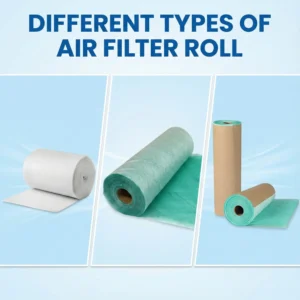 Different Types of Air Filter Roll Material Explained
  The Best Intake Filters for Flawless High-Gloss Finishes
 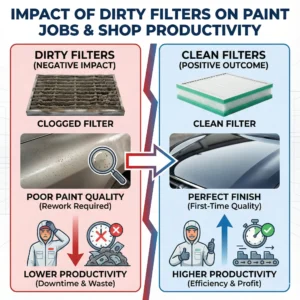 The Impact of Dirty Filters on Paint Jobs and Shop Productivity
  What Are Pre-Filters and Why Are They Essential in Paint Booths?