The Foundation of a Flawless Paint Job
In the world of high-quality finishing, from automotive refinishing to industrial coatings, the pursuit of a flawless surface is important. Achieving this level of perfection depends on controlling countless variables, but none is more fundamental than the air quality in the paint booth. This controlled environment is designed to eliminate imperfections, yet it’s constantly under threat from invisible enemies. This article will explore the critical role of a frequently overlooked component in this battle: the paint booth pre-filter. We will define what these filters are, explain their function, and demonstrate why they are not just an accessory but an essential foundation for achieving superior finish quality, operational efficiency, and significant cost savings.
The Pursuit of Perfection: Why Clean Air is Non-Negotiable in Paint Booths
A pristine paint job requires an environment completely free of airborne particulates. The slightest speck of dust or lint can become trapped in a wet topcoat, creating a surface flaw that necessitates costly and time-consuming rework. A professional spray booth is engineered to create a clean, pressurized envelope of air, ensuring that only purified air enters the cabin. This sterile atmosphere is the non-negotiable starting point for any high-caliber finishing process.
The Invisible Threat: Airborne Contaminants and Their Impact on Finish Quality
Outside the controlled environment of the paint booth, the air is saturated with contaminants. Dust from sanding operations, lint from clothing, pollen, and other debris can easily be drawn into the booth’s air intake system. If not captured, these particles will settle on the prepared surface, causing blemishes known as “nibs” or “fisheyes.” These defects ruin the finish, compromise the integrity of the coating, and directly impact a shop’s productivity and reputation.
Introducing the First Line of Defense: Paint Booth Pre-Filters
To combat this constant influx of contaminants, paint booths rely on a multi-stage filtration system. While final-stage ceiling filters often get the most attention for providing the last layer of purification, the true unsung hero of this system is the pre-filter. This is the first line of defense, designed to capture the largest and most abundant particles before they can compromise the rest of the filtration system.
What Exactly Are Paint Booth Pre-Filters?
Understanding the specific role and function of pre-filters is crucial to appreciating their importance within the larger ecosystem of a spray booth. They are the initial gatekeepers of air quality.
Defining the Initial Stage of Air Filtration
A paint booth pre-filter is the first filtration media that incoming air passes through in an air make-up unit (AMU) or intake plenum. Its primary purpose is to perform the initial, coarse stage of filtration. By trapping larger particles, it prepares the air for subsequent, finer stages of cleaning, ensuring a highly efficient and effective multi-stage filtration process.
How Pre-Filters Work: Capturing Large Airborne Particles and Debris
Pre-filters function by mechanical interception. As air is pulled into the paint booth by powerful fans, it is forced through the pre-filter media. This media is specifically designed with a fiber structure that is open enough to allow for high airflow but dense enough to trap larger particles like heavy dust, hair, insects, and sanding debris. This initial capture prevents these bulky contaminants from ever reaching the more delicate and expensive downstream filters.
Placement and Function within the Paint Booth’s Air Handling System (e.g., Air Make Up Units)
Pre-filters are strategically placed at the very beginning of the air intake system, typically within the Air Make-Up Unit (AMU) or at the main air inlet. In this position, they protect not only the subsequent paint booth filters but also the AMU’s sensitive internal components, such as heating coils and blower fans, from damaging debris buildup.
The Core Mission: How Pre-Filters Safeguard Superior Finish Quality
The benefits of a properly functioning pre-filter extend far beyond just trapping dust. Their impact is felt throughout the painting process, directly contributing to a better final product and a more efficient operation.
Eliminating Surface Imperfections and Rework
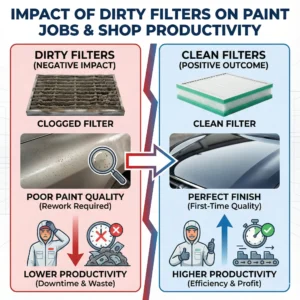
The most direct benefit of effective pre-filtration is the prevention of paint defects. By capturing coarse contaminants at the source, pre-filters drastically reduce the number of particles that can enter the spray booth and land on the wet surface. This leads to cleaner paint jobs, a dramatic reduction in polishing or “nibbing” post-application, and minimizes the need for complete rework.
Protecting Downstream Filters: Extending the Life of Primary Intake Filters
Secondary and final filters, such as bag filters or high-efficiency ceiling filters, are designed to capture extremely fine particles. However, they have a limited capacity for holding dust. Pre-filters act as a sacrificial shield, absorbing the bulk of the particulate load. This prevents the more expensive downstream filters from becoming prematurely clogged, significantly extending their service life and reducing overall filtration costs.
Preserving Optimal Airflow and Pressure Balance
Consistent airflow is critical for proper paint application and overspray control. When downstream filters become clogged, airflow is restricted, causing the fans to work harder and creating negative pressure or turbulence inside the booth. By keeping these finer filters clean, pre-filters help maintain the carefully engineered pressure balance and stable airflow required for a uniform finish.
Guarding Sensitive Paint Booth Equipment and Spray Guns
Airborne debris doesn’t just threaten the paint finish; it can also damage vital equipment. Dust and overspray can accumulate on fan blades, reducing their efficiency and lifespan. Particles can also find their way into compressed air lines and clog sensitive spray gun passages. Pre-filters play a crucial role in protecting this expensive capital equipment from premature wear and failure.
Anatomy of a Pre-Filter: Types and Their Applications
Pre-filters come in various forms, each designed for specific applications and contaminant loads. Selecting the right type is key to optimizing the performance of the entire filtration system.
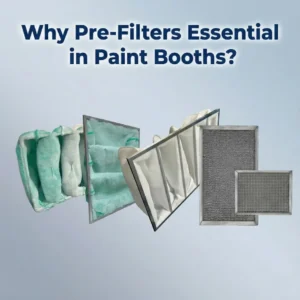
Media Pad Filters: Versatile and Widely Used
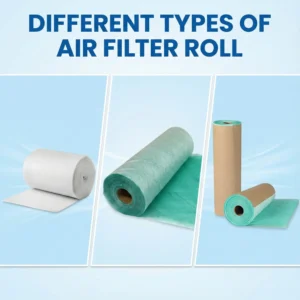
Often supplied in rolls or cut-to-size pads, these filters are made from polyester or fiberglass media. They offer a good balance of efficiency and dust-holding capacity and are an economical choice for many industrial and automotive applications. Some feature a tackifier to enhance their ability to capture and hold onto particles.
Panel Filters: Rigid Protection for Specific Needs
Panel filters are self-contained units with the filter media enclosed in a rigid cardboard or metal frame. Pleated panel filters are a popular choice, as the pleats increase the surface area. Allowing for higher dust-holding capacity and a longer service life compared to a flat pad filter of the same size.
Extended Surface Filters: Maximizing Dust-Holding Capacity
For applications with high dust loads, extended surface filters like bag filters or pocket filters are often used as a pre-filter or intermediate stage. Their deep pockets provide a vast surface area, enabling them to hold a large volume of contaminants while maintaining low resistance to airflow.
Specialty Pre-Filter Media for Specific Conditions (e.g., Scrim Bags, High Efficiency Diffusion Media)
Certain industrial settings or prep stations may require specialty pre-filters. Scrim-backed bags offer enhanced durability, while other high-efficiency media help the pre-filter stage meet specific air quality standards before the air reaches the main ceiling filters.
The Integrated System: Pre-Filters in the Paint Booth Ecosystem
A pre-filter does not operate in a vacuum. It is an integral component of a complex system where every part must work in harmony to achieve the desired result.
Strategic Placement: Upstream of Primary Intake Filters and Ceiling Filters
The pre-filter’s placement is always upstream—before—the primary intake and ceiling diffusion media. This hierarchical arrangement ensures a progressive filtration process. Where particles are removed in stages from largest to smallest, maximizing the efficiency and lifespan of each filter stage.
Integration with Air Make Up Units (AMUs)
The AMU is the heart of the booth’s air supply, and the pre-filter is its first line of defense. Proper integration ensures the AMU can deliver a consistent volume of clean, temperature-controlled air without being compromised by external debris.
How Pre-Filters Support Cross Draft and Down Draft Systems
Whether in a cross draft, semi-downdraft, or full downdraft booth, the principle remains the same. Pre-filters clean the incoming air before the system directs it across or down onto the workpiece. By ensuring this initial air is clean, they enable each booth design to perform its function of contamination control effectively.
The “Pre-Filter Advantage”: Beyond Just Clean Air
The true value of a robust pre-filter strategy is cleanliness, tangible operational, and financial benefits that impact entire business.
Significant Cost Savings through Extended Filter Life
Pre-filters are significantly less expensive than final-stage ceiling filters. By sacrificing themselves to capture coarse dust, they can double or even triple the life of the costly final filters. This “swap math” results in substantial savings on material costs and reduces the labor required for frequent change-outs.
Optimized Airflow, Pressure Management, and Energy Efficiency
When filters are clean, fans don’t have to work as hard to move air. Maintaining lower resistance to airflow (pressure drop) directly translates to lower energy consumption. This optimized performance reduces strain on fan motors and can lead to noticeable savings on electricity bills.
Enhanced Production Efficiency and Meeting Production Targets
Cleaner paint jobs mean less time spent on de-nibbing, buffing, and repainting. This reduction in rework allows technicians to move on to the next job faster, increasing throughput and helping the shop meet or exceed its production targets.
Contributing to Operator Safety and Environmental Regulations
While exhaust filters are primary for environmental compliance, pre-filters contribute to a cleaner, safer work environment by reducing the overall amount of dust circulating within the system. This improves the general air quality for operators inside the spray booth.
Smart Pre-Filter Maintenance: Maximizing Performance and Longevity
To unlock these benefits, pre-filters must be maintained properly. A proactive maintenance schedule based on performance indicators is far more effective than a simple calendar-based replacement. Regularly inspect pre-filters for visible dirt loading. Most importantly, monitor the pressure drop across the filters using a manometer or gauge. A significant increase in pressure indicates the filter is clogged and restricting airflow, signaling it’s time for a replacement. Timely changes are essential to prevent captured dust from migrating downstream and to keep the entire system running at peak efficiency.
Conclusion
The paint booth pre-filter is far more than a simple screen for bugs and leaves; it is a fundamental component of a high-performance finishing system. As the first line of defense, it is directly responsible for eliminating the contaminants that cause costly surface imperfections. Its role in protecting more expensive downstream filters provides a clear and immediate return on investment by reducing material costs and labor. Furthermore, by preserving optimal airflow and protecting sensitive equipment, pre-filters enhance energy efficiency and overall operational reliability. For any automotive or industrial finishing operation committed to superior quality. Elevating the pre-filter from an afterthought to a strategic priority is a critical step. Implementing a proactive maintenance and replacement strategy for your pre-filters is one of the simplest and most cost-effective measures you can take to guarantee a flawless finish, job after job.
 Spray Booth Filters Near Me: Fast Shipping & Sizing
  Different Types of Air Filter Roll Material Explained
  The Best Intake Filters for Flawless High-Gloss Finishes
  The Impact of Dirty Filters on Paint Jobs and Shop Productivity
  How Paint Booth Filters Help Maintain OSHA and EPA Compliance