
The Dual Defense: How Exhaust Filters Protect Your Shop’s Air Quality and the Environment
In the high-stakes world of industrial finishing and manufacturing, we often fixate on the visible elements of production: the sleekness of the coating, the speed of the line, or the precision of the cut. Yet, the unsung hero of a safe, compliant, and efficient shop is often hidden behind a grate, quietly doing the heavy lifting. This hero is the exhaust filtration system.
While many view exhaust filters as simple “dirt catchers” or a box to check for compliance, their role is far more profound. They serve as a dual defense system, standing guard on two fronts simultaneously. Internally, they shield your workforce and sensitive equipment from hazardous contaminants. Externally, they act as the gatekeepers of the environment, preventing your operation from becoming a source of pollution.
This article explores how modern exhaust filtration works as a twin shield, protecting the air inside your walls and the world outside them—and why upgrading your approach to filtration is one of the smartest investments you can make.
The Internal Shield: Protecting Your Shop’s Indoor Air Quality
The air inside your facility is the lifeblood of your operation. When it is compromised, everything from employee health to machine reliability suffers. A robust exhaust filtration system is the primary mechanism for scrubbing this air and maintaining a safe workspace.
Identifying Airborne Threats in the Workplace
Before we can appreciate the solution, we must understand the problem. Industrial processes generate a complex cocktail of airborne threats that are often invisible to the naked eye until they settle as dust—or manifest as a chronic cough.
Common Workplace Pollutants
-
Particulates and Dust: Generated by sanding, grinding, and cutting, these particles can linger in the air for hours.
-
Overspray: In paint booths, atomized paint that misses the target doesn’t just disappear; without capture, it drifts and coats everything in its path.
-
Volatile Organic Compounds (VOCs): Solvents, adhesives, and paints release these chemical gases, which are significant respiratory irritants.
-
Metal Fumes: Welding and thermal cutting release microscopic metal particles that are highly toxic when inhaled.
Health and Safety Benefits for Your Workforce
The most immediate beneficiary of effective exhaust filtration is the human being standing in the booth.
Mitigating Health Risks
Respiratory issues are among the most common occupational hazards in the finishing industry. Long-term exposure to isocyanates (found in many hardeners) and VOCs can lead to occupational asthma, sensitization, and even long-term organ damage. A high-efficiency exhaust system captures these contaminants at the source, drastically reducing the “body burden” on your employees. It turns a potentially hazardous zone into a controlled, safe environment.
Enhancing Productivity and Morale
There is a direct link between clean air and a better workplace. Technicians working in a haze of fumes suffer from fatigue, headaches, and eye irritation, all of which slash productivity. Conversely, clean air keeps alert levels high and fatigue low. Furthermore, showing your team that you invest in their long-term health builds loyalty and morale, reducing turnover in a tight labor market.
Safeguarding Equipment and Processes
Your employees aren’t the only ones breathing the air; your machines are too.
Protecting Sensitive Machinery
Modern manufacturing equipment, from CNC machines to industrial control panels, relies on cooling fans that suck in ambient air. If that air is laden with conductive dust or sticky overspray, it accumulates on circuit boards and heat sinks. This causes overheating and short circuits. Proper exhaust filtration stops this “dust creep,” extending the lifespan of expensive capital assets.
Ensuring Product Quality
In a paint booth, the exhaust filter plays a critical role in airflow balance. If filters are clogged or inefficient, they cause turbulence. This turbulence can blow dried overspray back onto a wet finish, causing defects that require sanding and repainting. Clean exhaust ensures that once the overspray leaves the gun, it leaves the booth for good.
Industry-Specific Applications for Internal Air Quality
Different environments face unique threats, requiring tailored filtration strategies.
-
Commercial Kitchens: Here, the enemy is grease and smoke. NFPA 96 standards dictate rigorous filtration to prevent grease buildup in ducts, which is a massive fire hazard.
-
Industrial and Automotive Painting: The focus is on capturing sticky, flammable overspray to prevent fires and protect the painter’s lungs.
-
Laboratories: Research facilities require ultra-pure air to prevent cross-contamination of samples and protect researchers from experimental fumes.
-
Data Centers: Even a microscopic amount of dust can catastrophic for servers; here, filtration is about maintaining a clinically clean environment to prevent hardware failure.
The External Guardian: Safeguarding the Environment Beyond Your Walls
Once the air leaves your facility, it enters the public domain. Here, your exhaust filters take on their second role: environmental stewardship.
Mitigating Harmful Emissions and Pollution
We live in a global society where industrial emissions are scrutinized more than ever. Your shop is part of a larger ecosystem.
Reducing Hazardous Waste
Effective exhaust filtration captures tons of particulates annually that would otherwise settle on local vegetation, cars, and homes. By trapping VOCs and toxic fumes, you prevent them from contributing to ground-level ozone and smog. This isn’t just about being “green”; it’s about being a good neighbor.
Meeting Environmental Regulations and Standards
Compliance is not optional. Regulatory bodies have strict codes that, if violated, can lead to shop-closing fines.
Adhering to Air Quality Regulations
Agencies like the EPA (in the US) and HSE (in the UK) enforce strict limits on emissions. Standards such as HSG258 (Controlling Airborne Contaminants at Work) require effective Local Exhaust Ventilation (LEV). Regular testing (like COSHH testing) ensures your system is actually protecting the air, not just moving air around.
Ensuring Fire Safety Compliance
For commercial kitchens and paint shops, fire codes are paramount. NFPA 96 and similar fire codes mandate that exhaust systems effectively remove combustible grease and paint laden vapors. A clogged or inefficient filter is a fuse waiting to be lit.
Embracing Corporate Environmental Responsibility
Beyond the legal minimums, leading shops are adopting a stance of corporate responsibility.
Enhancing Brand Reputation
Customers today prefer to do business with sustainable operations. Being able to market your shop as an eco-responsible business—one that filters its emissions and minimizes its carbon footprint—is a powerful differentiator. It positions you as a forward-thinking leader rather than a relic of the dirty industrial past.
Understanding the Mechanism: How Exhaust Filters Provide Dual Protection
How does a simple filter achieve all this? It comes down to the science of separation.
The Core Principle: Mechanical vs. Adsorption
Filtration generally relies on two distinct mechanisms:
-
Mechanical Filtration: This is like a physical net. It traps solid particulates (dust, paint, grease) within a fibrous matrix. As the air passes through, the particles get stuck in the weave of the media.
-
Adsorption Filtration: This deals with the invisible. Gases and vapors (like solvent fumes) pass right through mechanical filters. Adsorption uses materials like activated carbon, which acts like a chemical sponge, trapping gas molecules on its surface.
A Closer Look at Common Filter Types
-
Fiberglass and Polyester: The workhorses of the industry. Fiberglass is excellent for capturing bulk paint overspray due to its depth-loading capability. Polyester offers higher efficiency and is often used for finer dust or as a secondary stage.
-
Pleated Panel Filters: These fold the media into an accordion shape, drastically increasing the surface area. This allows them to hold more dirt and last longer without restricting airflow.
-
HEPA Filters (High-Efficiency Particulate Air): The gold standard for fine particles. HEPA filters can capture 99.97% of particles as small as 0.3 microns. These are essential in hospitals, labs, and for recirculating air systems.
-
Activated Carbon: Essential for odor and VOC control. If your shop uses solvent-based paints or generates noxious fumes, carbon filters are the only way to neutralize the chemical hazard before exhausting the air.
The Role of the Complete Exhaust Filtration System
A filter does not work in isolation. It is part of a system involving:
-
Local Exhaust Ventilation (LEV): Capturing the contaminant right at the source (e.g., a welding arm or a spray hood) so it never enters the general breathing zone.
-
Ductwork and Stacks: Transporting the dirty air efficiently to the filter banks.
-
Fans: Providing the necessary “pull” (static pressure) to overcome the resistance of the filters.
Beyond the Filter: Integrating Exhaust Systems for Optimal Performance
To truly maximize the “dual defense,” you must look at the bigger picture of airflow management.
The Importance of Proper Ventilation and Airflow Patterns
You cannot exhaust air that you do not replace. If you suck 10,000 CFM (cubic feet per minute) of air out through your exhaust filters but only let 5,000 CFM back in, your building goes into negative pressure.
The Role of Make-Up Air Fans
Make-up air units (MAUs) force fresh, conditioned air into the building to replace what the exhaust pulls out. This balances the pressure. Without make-up air, doors slam shut, exhaust fans struggle to pull air (reducing filter efficiency), and you may even suck carbon monoxide from heater vents back into the workspace.
Synergy with Other Air Management Systems
-
Pollution Control Units (PCUs): For heavy industrial or commercial kitchen applications, a standard filter bank isn’t enough. PCUs are advanced units that combine multiple stages of filtration (often including electrostatic precipitators and UV scrubbers) to virtually eliminate smoke and odors before the air hits the outside world.
-
HVAC Integration: Your exhaust system and your heating/cooling system must talk to each other. An integrated design ensures that you aren’t exhausting all your expensive heated air unnecessarily, perhaps by using heat recovery ventilators.
Designing for Specific Contaminants
Finally, customization is key. A shop cutting granite (heavy silica dust) needs a vastly different setup than a shop spraying clear coat (sticky mist).
-
Heavy Particulate: Requires “baghouse” style dust collectors or cyclone separators that can handle massive volumes of dust without clogging instantly.
-
Fume-Intensive: Requires high-velocity capture at the source and heavy banks of activated carbon to treat the chemical load.
Conclusion: A Smart Investment
Your exhaust filters are not just consumables; they are your facility’s immune system. By understanding and optimizing this “dual defense,” you protect your most valuable assets—your people and your equipment—while securing your reputation as a responsible, compliant, and modern operation. Don’t let your profits vanish into thin air; trap them, and the contaminants, with a superior filtration strategy.
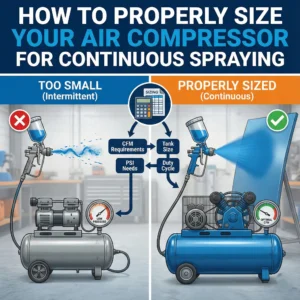 How to Properly Size Your Air Compressor for Continuous Spraying
  Best Practices for Tracking and Scheduling Paint Booth Filter Changes
  The True Cost of Running a Paint Booth with Clogged Filters
  How to Improve Shop Efficiency with the Right Paint Booth Accessories
 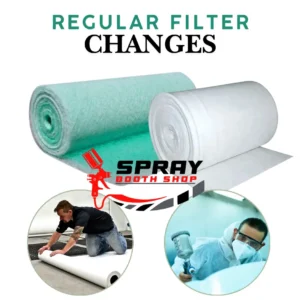 How Regular Filter Changes Save Your Shop Time and Money