
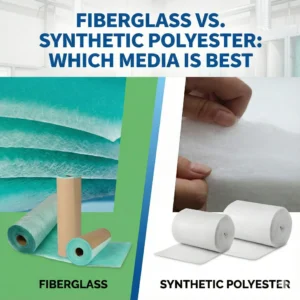
Fiberglass vs. Synthetic Polyester: The Essential Guide to Matching Media with Your Specific Paint
In the world of professional painting and finishing, the pursuit of a flawless surface is paramount. While focus is often placed on spray guns, paint chemistry, and application technique, a critical component operating behind the scenes has an outsized impact on the final result: the air filtration media. The quality of the air in a spray booth or finishing environment directly translates to the quality of the finish, making the choice of filter media a decision that warrants careful consideration.
Why Filtration Media Matters More Than You Think
Every airborne particle—dust, lint, or even overspray from a previous job—is a potential defect. Effective air filtration is the first line of defense against contaminants that can cause imperfections like “fish eyes,” rough texture, and poor adhesion. The right filter media ensures a controlled environment, protecting both the workpiece and the air quality for operators.
Fiberglass vs. Synthetic Polyester: The Core Dilemma
The two dominant materials in this space are fiberglass and synthetic polyester. For decades, fiberglass has been the traditional, cost-effective standard. However, modern synthetic media, primarily polyester, has emerged as a high-performance alternative, creating a choice between initial affordability and long-term performance. This decision directly impacts everything from finish quality and operational efficiency to maintenance costs and worker safety.
What This Guide Will Cover: Matching Media to Your Specific Paint Needs
This guide moves beyond a simple pros-and-cons list. We will delve into the technical characteristics of both fiberglass and synthetic polyester, connecting their inherent properties directly to the demands of different paint chemistries and application scenarios. By the end, you will have a clear framework for selecting the optimal filtration media that aligns with your specific operational needs, ensuring a superior finish every time.
Understanding Fiberglass Filter Media: The Traditional Choice
Fiberglass has long been the go-to material for spray booth filtration, primarily due to its low upfront cost. As a foundational technology in air filtration, it serves a specific purpose but comes with notable limitations that are critical to understand.
Composition and Characteristics: Glass Fibres, Mechanical Entrapment
Fiberglass media is composed of fine strands of glass woven into a progressively dense mat. Its primary filtration mechanism is mechanical entrapment. As air passes through the filter, larger paint overspray particles and dust collide with and adhere to the fiberglass fibers. The media is typically less dense on the air-entry side and becomes denser on the air-exit side, allowing for “depth-loading” of particles throughout the filter’s thickness.
Advantages: Cost-Effectiveness and Initial Particle Capture
The most significant advantage of fiberglass filters is their low initial purchase price, making them an attractive option for operations with tight budgets. They are effective at capturing larger, heavier paint particles and can handle high volumes of overspray in certain applications, preventing the bulk of contaminants from exhausting into the atmosphere.
Disadvantages: Fiber Shedding, Moisture Susceptibility, Limited Durability
The primary drawback of fiberglass media is the potential for fiber shedding. Small fiberglass fibers can break off from the media, especially during installation or pressure fluctuations, and become airborne. These fibers can land on a wet surface, creating critical finish defects. Furthermore, fiberglass is hygroscopic, meaning it can absorb moisture, which can lead to degradation and reduced performance, particularly in humid environments or with water-based paints. Its overall durability is lower than synthetic alternatives, often requiring more frequent replacement.
Common Applications: General Purpose Filtration, Initial Stage Overspray Capture
Due to its cost and performance characteristics, fiberglass media is best suited for general-purpose spray booths where finish quality is less critical. It often serves as a primary or initial-stage filter for capturing the bulk of overspray before air moves to a more efficient secondary filter.
Understanding Synthetic Polyester Filter Media: The Modern Solution
Synthetic polyester represents a significant advancement in filtration technology. Engineered for higher performance, durability, and safety, this synthetic media addresses many of the inherent weaknesses of traditional fiberglass, making it the preferred choice for demanding finishing applications.
Composition and Characteristics: Synthetic Fibres (Polyester), Advanced Filtration Mechanisms
Synthetic filter media is made from polyester fibers that are thermally bonded into a multi-layered material. Unlike the random matrix of fiberglass, polyester media is often engineered with specific densities and fiber diameters throughout its layers. This construction allows it to capture a wider range of particle sizes more effectively.
Advantages: Superior Filtration Efficiency, High Dust-Holding Capacity, Durability
The standout advantage of polyester is its superior filtration efficiency, especially for the fine particles that fiberglass often misses. This results in cleaner air and a lower risk of surface contamination. Polyester also boasts a significantly higher dust-holding capacity, meaning it can trap more contaminants before needing replacement, leading to a longer service life. Its inherent strength provides excellent durability, resisting tearing and degradation over time.
Key Features: Moisture Resistance, Reduced Fiber Shedding, Consistent Airflow
Polyester is hydrophobic, meaning it repels water. This moisture resistance makes it ideal for use with water-based coatings and in high-humidity environments. The fibers are strong and bonded securely, drastically reducing the risk of fiber shedding. This ensures that the filter itself does not become a source of contamination. A well-designed synthetic filter also maintains more consistent airflow as it loads, preventing a sharp increase in pressure drop.
Construction Variations: Pleated Filters, Multi-Stage Filtration Systems, Electrostatic Attraction
Polyester media can be manufactured in various forms. Pleated filters increase the surface area for filtration without increasing the filter’s size, enhancing dust-holding capacity. In multi-stage systems, different layers of polyester media are combined to target different particle sizes. Some synthetic media is also electrostatically charged to attract and hold fine particles through static attraction, further boosting filtration performance.
Common Applications: Automotive Spray Booths, Fine Finishing, Demanding Industrial Coatings
The high performance of polyester makes it the standard for applications where finish quality is non-negotiable. This includes automotive refinishing, aerospace coatings, fine furniture manufacturing, and any industrial process requiring a pristine, defect-free surface.
The Critical Link: Paint Chemistry, Properties, and Media Interaction
The interaction between your paint’s chemical makeup and your filter media is a critical, often overlooked factor that directly influences performance and finish quality.
Solvent-Based Paints: Assessing Chemical Resistance and Media Degradation
Aggressive solvents found in many industrial coatings can degrade filter media over time. Synthetic polyester offers superior chemical resistance compared to the binders used in some fiberglass filters, ensuring structural integrity and consistent performance throughout its lifespan.
Water-Based Paints: The Importance of Moisture Resistance and Dimensional Stability
The rise of water-based paints makes moisture resistance a crucial feature. Fiberglass media can absorb moisture from the overspray, causing it to swell or sag, which can compromise the filter’s seal and effectiveness. Polyester’s hydrophobic nature ensures it remains dimensionally stable, maintaining optimal filtration performance regardless of the paint type.
High-Solids and High-Viscosity Paints: Impact on Dust-Holding Capacity and Pressure Drop
High-solids paints create a dense, heavy overspray that can quickly clog a filter. Fiberglass filters, with their lower dust-holding capacity, will load rapidly, causing a spike in pressure drop and restricting airflow. The high dust-holding capacity of a synthetic filter allows it to capture this heavy overspray for longer while maintaining workable airflow, extending replacement intervals.
Specialty Coatings: Unique Demands for Filtration Precision (e.g., anti-slip coatings, fire-resistant paints)
Specialty coatings may contain abrasive or unique particulates that require a durable filter medium. The robust, tear-resistant nature of polyester makes it better suited to handle these demanding materials without shedding or breaking down.
Adhesion and Contamination: How Media Choice Directly Impacts Paint Adhesion and Finish Quality
This is the most direct link. If a fiberglass filter sheds fibers onto a prepped surface, the paint will adhere to the fiber, not the substrate, creating a weak point and a visible defect. The cleanliness provided by a non-shedding synthetic polyester filter is essential for achieving maximum paint adhesion and a flawless finish.
Matching Media to Specific Paint Application Scenarios
Applying this knowledge to real-world situations clarifies which media is right for the job.
Automotive Refinishing & High-Gloss Finishes: Demanding Flawless Results
For high-gloss automotive topcoats, any microscopic contaminant can ruin the finish. The superior filtration efficiency and non-shedding nature of synthetic polyester are mandatory to achieve a mirror-like result.
Industrial Coating & Harsh Environments: Prioritizing Durability and Chemical Resistance
In industrial settings using harsh chemical coatings, the durability and resistance of polyester media ensure filter longevity and protect equipment from corrosive overspray.
Furniture Manufacturing Spray Rooms & Fine Wood Finishing: Mitigating Dust and Paint Mist
Fine wood finishing is extremely sensitive to dust nibs. Polyester filters excel at capturing the fine airborne dust common in woodworking shops, ensuring a perfectly smooth lacquer or varnish finish.
Artistic & Custom Painting: Achieving Absolute Perfection
For custom and artistic work where every detail counts, the clean-air environment created by high-efficiency synthetic media is essential for realizing the artist’s vision without compromise.
General Purpose Spray Booths: Balancing Performance and Cost for Diverse Paint Jobs
For general fabrication or jobs where a Class-A finish is not the primary goal, fiberglass filters can offer a viable balance between acceptable performance and low initial cost. The key is understanding the trade-off in finish quality and replacement frequency.
Key Performance Metrics & Their Direct Impact on Paint Quality
Understanding technical ratings helps in making an informed choice.
Filtration Efficiency & MERV Ratings: Capturing Paint Overspray Particles and Contaminants
Filtration efficiency measures what percentage of particles a filter can capture. This is often expressed as a MERV (Minimum Efficiency Reporting Value) rating. Basic fiberglass filters typically have low MERV ratings (1-4), effective for large particles. High-efficiency synthetic filters achieve much higher MERV ratings, enabling them to capture the finer, more problematic contaminants that ruin high-quality finishes. Selecting a filter with an efficiency rating appropriate for your finish requirements is crucial for preventing defects.
Conclusion
Choosing between fiberglass and synthetic polyester filter media is far more than a simple cost comparison; it’s a strategic decision that directly impacts your final product quality, operational efficiency, and total cost of ownership. While fiberglass offers an attractive low initial price for general-purpose applications, its limitations—such as fiber shedding, moisture susceptibility, and lower filtration efficiency—can introduce significant risks and long-term costs in the form of finish rework and frequent replacement.
Synthetic polyester, with its superior filtration performance, high dust-holding capacity, durability, and resistance to moisture and chemicals, represents the modern standard for any application where finish quality is a priority. By aligning your filter media choice with the specific chemistry of your paint and the demands of your application—whether it’s the flawless gloss of automotive refinishing or the rugged durability of industrial coatings—you invest in consistency, quality, and efficiency. To make the right choice, evaluate your most common paint jobs, assess your quality standards, and choose the media that provides the cleanest possible environment for success.
 DIY Troubleshooting: Common Paint Booth Filter Problems and Solutions
  Top 10 Paint Booth Accessories Every Auto Body Shop Must Have for Quality Finishes
  Spray Booth Regulations for Colorado
  Spray Booth Monitoring